People are always asking me, "Who's the best player you ever saw?"
I tell them that's not a fair question. There are so many factors you have to consider: The era a man played in, the caliber of his teammates, the types of systems his coaches installed, and how well those systems were tailored to his particular skills. These are all important considerations.
A John Havlicek for instance would have been outstanding wherever he played. But a Bob Cousy? No way. He would not have been an outstanding player if he ended up someplace like Chicago in the kind of slowed-down game played when Dick Motta was there. Cousy would have been stifled; he needed a running game.
Quite often, the team makes the player - more often, in fact, than the player making the team, though it can work both ways. There's an old line about how the strength of the wolf is in the pack, and the strength of the pack is in the wolf; there's some truth on both sides. But though it's nice to have a guy who'll get you 35 points a game, that's not enough to win. Bernard King can score 55 points and the Knicks might still lose. It's happened. It used to happen all the time with Wilt Chamberlain. That year he averaged 50.4 with the old Philadelphia Warriors, we finished 11 games ahead of them.
But all factors being considered, if I had to pick the best of all, the answer would be easy.
Bill Russell and Larry Bird.
And I'm not picking them just because they're my guys; I'm calling them the best of all time because they are the best of all time.
Okay, you say, but there's a draft tomorrow - the hypothetical all-time draft - and I've got the first pick. Whose name do I call? That would be the hardest thing in the world for me to decide. I'll tell you why - and then I'll tell you whom I'd pick.
A one of a kind
When Russell quit in 1969 I knew in my heart that we'd never see anything like him again, and no one's ever come along to change that opinion.
I'll be the first to admit I didn't know what we were getting when we drafted Bird. But people forget that it was the same thing when we drafted Bill. I knew we were acquiring someone who'd get us the ball. That was our big need back in '56, the one missing element that could make us a great, great team.
I'd heard about Russell when he was a sophomore at San Francisco. My old college coach, Bill Reinhart had seen him play. He came back and told me, "Red, you've got two years. Start planning now. This kid can be outstanding." Reinhart was the first to spot it.
So, yes, getting him was premeditated. It was no accident. We wanted Russell. And we went after him, working out a deal with St. Louis in which we gave them Ed Macauley, who was our all-star center, and Cliff Hagan, who was just coming out of the Army and was certain to be a top-notch forward. In return we got their first pick, which was the number two pick in the draft that year. Rochester had the first pick overall, but we already knew that they were taking Sihugo Green of Duquesne. We took Russell.
Did I know what I was getting? Not really. A great rebounder? Sure. But I knew nothing about his character, his smarts, his heart; things like that. You never know those things until you actually have the guy. No one in the league really thought much about it at the time. They certainly didn't know what was about to happen: 11 Boston championships in the next 13 years.
Most of your centers in those days - Mikan, Pettit, Johnston - were also your predominant scorers, and here was a guy who, word had it, couldn't hit the backboard; that wasn't really true, but that was the rap against him.
After we made the deal to get him, Walter Brown, our owner at the time, went with me to watch him perform in an exhibition game the Olympic team was play at the University of Maryland. He was terrible. Just awful! Walter and I sat there looking at each other all night. What in the world had we done?
But later that night, after the game, Russell came over to see us. "I want to apologize," he said. "I am really embarrassed. That was the worst game I ever played."
So we talked about it, then got onto other things and it was never mentioned again. At the end of the night, after Russell left, Walter turned to me and asked, "Well, what do you think?"
"I was worried for a while," I told him. "But after looking into his eyes and hearing him talk like that, I'm not worried anymore."
From gold to goofing off
Russ joined us in December 1956, after leading the Olympic team to a gold medal in Melbourne. I brought him into my office and we had a little talk.
"You're probably worried about scoring," I suggested, "because everyone says you don't shoot well enough to play ball."
"Well, yes," he smiled, "I am a little concerned about that."
"Okay," I told him. "I'll make a deal with you today, right here and now. I promise that as long as you play here, whenever we talk about contracts we will never discuss statistics."
We never did. There was only one statistic that mattered to Russell, and it was the same one that mattered to me: Wins.
"Russ," I said, "we have a pretty good organization here. No cliques. Everyone gets along real well. All we want you to do is something no one's ever been able to do for this team: Get us the ball. Forget everything else. Just get the ball."
He nodded and smiled again. "I can do that," he said.
A lot of great basketball minds didn't think he would make it, and if you analyzed their thinking, you could see their point. Take a guy like Walter Dukes. He was bigger than Russell, and he could shoot better. Why, then, was Russell so great while Dukes was just another player?
It was his ability to perform in the clutch. It was his brilliant mind. It was his great defensive anticipation, which led to his great ability to intimidate. And in addition to all of his innate abilities, Russell was a student of the game. Sure, he had quickness, reaction, all the tools he needed. But most of all, he was a thinker. If you faked him a certain way and wound up making a basket or grabbing a rebound, he'd file it away in his mind, and you'd never fool him the same way again.
We played the Knicks in one of his early games with us and Harry Gallatin ate him up. Harry knew his way around. He was cute. So the next time we played New York I started telling Russ: "You take so-and-so and I'll have Heinsohn take Gallatin."
He didn't say anything at first, but then he pulled me aside just before the game started.
"I'd like to play Gallatin," he said. "It won't happen again."
I said okay, and as I watched him walking onto the court I knew that this was a momentous occasion. He killed Gallatin. See, his pride had been wounded, and that made Russell a dangerous man to deal with. It's like they say in the jungle: Don't ever wound a lion, or he'll be twice as deadly. When Russell's pride was hurt he became like that wounded lion, and God help anybody who got in his way.
I remember one day when I really got angry at him in practice. Russell hated practice. Everyone knew it, but none of us made a big deal about it because we knew the guy would give us 48 tough minutes every game. So I'd shut my eyes to the false hustle he was giving. Still, practice had its purpose, even for him, especially when we were working on plays. And sometimes I'd want him to put out just so he wouldn't upset the other players' timing. Those were the only times when I'd really get on him; otherwise, I'd allow him to set his own pace, figuring I didn't want him leaving all of his energy in a workout.
But one particular morning he was loafing more than usual, and pretty soon everyone else started goofing off, too. So I blew my whistle. "Okay," I said, "are we all done resting now? Good. Let's go! Let's have a twenty-minute scrimmage, real strong, and then we can all get out of here."
So they start in, but pretty soon they're loafing again. Now I blow my whistle and I'm steamed. "Out! Everybody out. Right now. Don't let me hear another ball bounce. Just get out."
They all scrammed, wondering what I was going to do next. But I wasn't going to do anything. The feeling just wasn't there that day, that's all. It happens sometimes. You have to know when to push and when to back off.
Now comes our next practice. "Listen up," I tell them. "We will not discuss what happened before. All I want is a good, hard practice today. Let's go."
Sure enough, Russell starts in loafing again. All he's giving me is more false hustle. I stop the practice.
"Damn it, Russell," I yelled. "You destroyed practice the other day, but you're not going to destroy this one. I'm going to go up into those stands, light a cigar, and I'm going to sit there two hours, three hours, four hours - whatever it takes - until I see a good 20-minute scrimmage. I don't care if you're here all day long. I'm going to see a workout, so make up your mind to that now."
I grabbed some cigars, went into the stands and blew the whistle for them to start.
They began to play, and after five minutes I started to laugh. I couldn't help it. Russell must have blocked 9,000 shots. He'd grab a rebound, throw the outlet pass, race down court to stuff in a shot, then beat everybody back on defense, where he wouldn't allow anyone to get within 18 feet of the basket. I watched this incredible display and thought to myself, "If I don't stop this right now, he's going to leave his next game right here in the Cambridge Y."
I decided the only way to handle it was to make a joke of it, so I blew my whistle and walked back onto the court.
"Russell," I said, "what the hell am I going to do with you? I didn't mean for you to play that good. Can't you give me a happy medium!"
The Russell magic
Bill's calling card, his speciality, was the blocked shot. I began to notice that he didn't block shots the way all the other big guys blocked them. Chamberlain and all those other guys were what I called shot-swatters - 7-foot fly-swatters - who'd knock the ball out of bounds, or else belt it into the open court where anybody could retrieve it.
Russell didn't do that. With his great timing and body control, he'd hit the bottom of the ball, forcing it to pop up into the air like a rebound, which he'd then grab. Or else he'd redirect it into the hands of one of his teammates. Either way, we ended up with possession. He turned shot-blocking into an art, and he's the only man I've ever seen on a court who could do that on a consistent basis. No one's ever been able to duplicate, his style, although Bill Walton came the closest when he was healthy.
Russell, took that one great skill and revolutionized the game by terrorizing the league. As word spread and his reputation grew, he began instilling fear into the hearts of all the great shooters. He didn't react the way other centers reacted, so these shooters never knew how to react to him. Most shot-blockers, anticipating a shot, would go into the air with the shooters. Not Russell. He was so quick, so fast, that he wouldn't make his move until after the ball had left the shooter's hand. Against other centers, they'd just go behind a screen, or fake, or maybe double pump. That didn't work with Russell. He'd just stand there, watching you, waiting for you to commit yourself. The moment you released the ball, he'd be on it like a cat.
S hooters would come racing down the court, stop, and go up for a jumper - but hesitate just long enough to ask themselves, "Where is he?" And that split-second was all it took for one of our other guys to catch up to them. In situations like those, which we saw all the time Russell didn't have to move an inch to break up a play. His presence alone was so unnerving that opposing players would blow their shots just worrying about what he might do.
I used to lead teams of NBA stars on State Department tours all over the world. One summer our tour took us to Yugoslavia. When we offered to put on clinics, as we did wherever we went, the officials there told us they weren't interested. Apparently some AAU team had been there, before us and was beaten easily by the Yugoslavian national team.
We tried to explain that there was a big difference in our country between pros and amateurs, but they didn't want to hear anything about it. All they knew was that the guys they had whipped had worn USA on their jerseys. There was nothing they wanted to learn from us, they said, and they were pretty arrogant about it.
That irritated me. I wanted to set the record straight, to show the fans over there that they hadn't seen the best America could offer, because of course that's never explained to them whenever poorly-trained pickup teams of American kids get their asses handed to them by pros behind the Iron Curtain.
Yugoslavia had this redheaded center who was the leading scorer in all of Europe. So I pulled Russell aside just before the game got under way. "Look," I told him, "don't worry about the ball tonight. Don't worry about rebounds. Let Pettit and Heinsohn worry about that stuff. All I want you to do is guard that big kid over there. If he scores one basket, I'm going to break your neck. Understand?"
We start the game and the kid gets the ball. He fakes right, bounces once to his left, then goes up into the air - and you can see this big smile on his face. All of a sudden, Russell uncoils his arm. Blocked shot. We take the ball to the other end of the court and score.
This happened again. And again. And again. Russell blocked about six shots in a row, and now the kid's going bananas. He comes down the court a seventh time, takes two steps backward and throws the ball like a baseball.
"Damn it, Russell," I yell, "you let him hit the backboard!"
Russ looks at me. Now he's figuring he's got to find a way to get both the kid and me off his back. So the next time the guy takes a shot, instead of blocking it again he smacked it as hard as he could and it hit the kid in the face. He began screaming, going into a tantrum like a three-year-old, and he winds up kicking the ball into the crowd.
That was it for him. Technical foul. They threw him out of the game - the hero of the country, mind you. He had seen all he wanted to see.
That's what Russell could do when he put his mind to it.
From player to coach
Would we have had the success we enjoyed without Bill Russell? No way. But would he have had the same success if he played for another coach? I don't know.
I do know this. When I let it be known at the start of the 1965-66 season that I was beginning my final year of coaching, he came to me, more than once, and urged me not to quit. He called my wife and urged her not to let me quit.
Then one day late in that season, when he realized my mind was made up, he came to me and said he'd like to take over as coach when I retired. His reason was that he didn't want to play for anyone else. Suppose he didn't like the new guy? Or suppose the new guy brought in a different system after all these years?
Well, my mind started moving pretty fast. Suppose the new guy didn't understand Russell? Suppose they weren't able to develop a productive chemistry? I started thinking the same way Russell was thinking.
"I don't want to play for anybody else," he told me. "If I can't play for you, I'd rather play for myself, if you'll let me have the job."
I jumped at the idea. What better way to motivate Russell, I thought to myself, than to make him accountable for the whole team's performance? Remember, the year I left the bench we won our eighth championship in a row. Every season it became more difficult to sustain the intensity. But I knew Russell's pride, and if anybody could get the most out of Russell the player, it would be Russell the coach. Now there would be two reasons he had to win! Talk about a great self-motivating situation.
At our breakup banquet that spring, after all of the other speakers had been to the mike, Russ got up and talked about replacing me. He was leading up to a point, and when he got there he turned and looked directly at me.
"People say Red was lucky to have me," he said. "And he was. But I was lucky to have him, too. Red, you and I are going to be friends until one of us dies."
My throat got tight and my eyes filled and I had to look away. Lucky to have him? You bet I was.
I'm not much for showing my emotions in public, but I did that night.
I almost did it again when they had that big weekend for me in Boston. After all of my old players, from the '50s, '60s, '70s, right down to the present club, had assembled on the Garden court, they announced my name, and I walked out into the middle of a tremendous ovation. It was very emotional, but I was in full control as I started shaking hands with each old Celtic.
Then as I started moving toward Russell he held his arms out, and I stretched my arms, and the next thing I knew he was lifting me off the floor and holding me in a bear hug. Everyone was cheering, but all I was thinking was that I didn't want to cry because I was afraid I might not be able to stop. I almost cracked, but I got through it.
You see, what Russell and I share will always be special. My wife loves the guy. I love the guy. I understand him, just like he understands me. As he once said, we have the most essential ingredient for friendship, and that's mutual respect. He made no demands of me, and I made no demands of him. As he likes to say, we "exchanged favors."
One year, the night before training camp opened, I called him to my room. "Russ," I told him, "I'm going to yell at you all day long tomorrow. I may yell at you all week long. Don't pay any attention to it, okay? You see, if I can't yell at you, then I can't yell at anybody." He said that would be okay, so for the next couple of days I really climbed all over him, and he didn't react. I figured that was because of the little agreement we'd made. It wasn't until later that he told me I'd gotten him so mad he wanted to kill me. I was such a good actor that I guess I forgot I was acting.
Other times he'd come to me and ask if he could skip a practice, or maybe travel ahead by himself and meet the team on the road. It didn't happen often, but if I thought it really meant a lot to him I'd sometimes go along with his request. And I'd always add one condition: "You owe me one."
He'd laugh and say okay. Some night, maybe a month or two later, We'd be getting ready for a tough one and. I'd go over to him.
"You owe me one, right?"
"Right."
"Well, I want it tonight."
Then he'd play his heart out.
Today, when I look back in private thoughts, I enjoy reflecting on some of the things I did which helped win games. And I'm sure Bill, in his private thoughts, enjoys the same type of reflections. Many of those thoughts - his and mine - go hand in hand. We were a lot alike: Two strong personalities, both having the same goals, the same philosophies, both doing anything and everything we could to achieve the triumphs that meant so much to both of us.
I think it's safe to say there's a bond between us that very few men will ever be privileged to share.
The private side
I've always wished the public could know the Russell I know, but he's a very private man who's hard to get to know. He just wants to be left alone.
There have been things he's said and done - like refusing to let us formally retire his number, which we did without him, or refusing to attend his own enshrinement in the Hall of Fame - that I have not agreed with, and I've told him so.
Yet throughout his playing days I didn't want to go into his personality or eccentricities unless I felt I had to. That was Russell. That was his thing, so to speak. Other than giving advice where I felt it was welcome or needed, I made no attempt to change him. Who knows? If I had tried to change his personality it might have affected the way he played.
I'll always remember the time I heard him speaking off the cuff to some students at Notre Dame. We were there for an exhibition, as I recall, and it was during the period of great campus upheaval: Civil rights, Vietnam, protests. It seemed students were mad at everyone and raising hell every chance they got.
I watched Bill sit on the edge of a stage and rap with those kids, and all the respect I had for him doubled. He was so articulate, so down-to-earth, so open and honest - and all these kids, including the long hair types, sat with their eyes wide open, fascinated by what they were hearing. I don't know of anybody else in the country who could have held that particular audience under that kind of control. Even today, if he'd go around talking to kids the way he did back then, he'd do a better job of communicating with them than just about anybody else in the nation.
That's the Bill Russell too few people ever get to know.
Heirs to greatness
Will there ever be another Russell?
I don't know. I think the next Dr.J is already here; his name is Michael Jordan. And we might be seeing the next Bob Cousy in Isiah Thomas.
But another Russell? I don't know about that. Patrick Ewing's no Russell. He's a great player and a super kid, but he's a power center; Russell was a finesse center. A guy who'd have a shot at being a Russell-like center if he wasn't so offensive-minded is Ralph Sampson; he's got the quickness, the smarts and the reactions. Akeem Olajuwon? Keep your eyes on him. He might be the one.
I'll always remember what Russell said the first year of his retirement when Kareem Adbul-Jabbar, then known as Lew Alcindor, came into the league with a great flourish. Someone asked Russell, "How would you have done against Alcindor?"
I think that bothered Bill. He was never one to use the word "I" a lot; he never had that kind of ego. But here was this kid, this great offensive machine, creating such a stir that already people were forgetting the way Russell had dominated every center he ever faced.
"The question," he told the interviewer, "is not how I would have done against Alcindor, but rather how Alcindor would have done against me."
It was a great line, and he was absolutely right to have said it.
When you think about it, maybe that's the only way to measure the next Bill Russell: How would he have done against the original Bill Russell? Personally, I don't think I'll live to see the man who might have beaten him.
Another flies in
You're always looking, always hoping, to find the next great one, and back in 1977 we started hearing rumors about this kid out at Indiana State. No one ever said he was great at that time, but the word was that he was good, very good. So I watched him on TV a couple of times, and then, during his junior season, I went to see him in person for the first time.
Like Russell, Larry Bird showed me what I wanted to see the first time I laid eyes on him. Here was a kid who could shoot and who knew how to handle the ball. He was going to be eligible for the draft that spring, 1978, even though he was a junior, because he started his collegiate career at Indiana and then sat out a year. But he made it known he intended to play his senior season. Anybody drafting him would have to wait a year. Most teams don't want to do that, but we looked at it differently. Back in 1953 I drafted three Kentucky players - Frank Ramsey, Cliff Haan and Lou Tsioropoulos - a year before they graduated. Like Bird, they were all junior-eligibles.
Why? Because you'd rather have potential great fresh-blood than potential good fresh blood coming into your organization. Any good player you draft probably won't make that big a difference, but a great player can make all the difference in the world. So what's one year? It goes by very quickly, and it's well worth the wait if the player you're talking about has the potential for making a major impact upon your team.
Larry, I felt, had that potential - yet I didn't even dream of the surprises which were to come. I didn't realize how quick he was. I had no knowledge of his rebounding abilities. I knew he had a court presence on offense, but I didn't realize he had one on defense, too. And I had no sense of his leadership qualities, or his ability to motivate other people as well as motivating himself.
I had no great insight into his character, or his personality, or his willingness to play in pain. I have never had an athlete in my 39 years in the league who liked to play more than Larry does and who would make every effort to play, whether he was hurt or not. He symbolizes that old line he can walk, he can play better than any athlete I've ever met.
Yet he was drafted solely on the premise that he was a damned good ballplayer who could put some points on the board and move the ball around. That's all I was expecting, just as I was only expecting Russell to get us the ball.
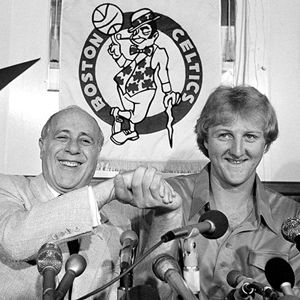
We had a terrible season in 1977-78- (32-50) but the one thing it gave us was the sixth pick in the first round. So we waited until the first five names were called: Mychal Thompson, Phil Ford, Rick Robey, Mike Richardson and Purvis Short. Then, it was my turn to speak: Boston takes Larry Bird of Indiana State.
The following spring, after his senior season, I opened negotiations with his agent, Bob Woolf. They lasted three months and at times were somewhat heated, though a lot of that was just newspaper talk.
I knew Larry was going to cost us some money, and I was prepared to pay a reasonable price, but the point I kept hammering home was that no forward ever made a franchise in our league. And historically, I was correct. The only guys who ever had the ability to turn around an entire franchise were centers: Mikan, Russell, Chamberlain, Reed, Jabbar, Walton, Malone. All of your other players, no matter how great they were, were contributors. Look at Dr.J - as great as he is, he didn't win it all until Malone joined him. No forward could do it by himself, because forwards are at the mercy of the guards; the guards control the ball.
That's why no forward ever made a franchise - until Larry Bird made ours. He was the first exception, and he may go down in history as the only exception.
The day he walked into our rookie camp was the day my eyes were opened: The way he shot the ball; the way he passed it around; the way he crashed the boards; the way he raced up and down the court; the way he controlled the tempo and action; the way he seemed to make no mistakes. As I sat there watching, all I could think of was the day Havlicek first showed up 17 years earlier. It was the only thing I could compare it to.
John had just been cut from the Cleveland Browns camp. He flew into town, someone picked him up, and the next thing I knew he was walking onto the court. Ben Carnevale, the Navy coach was with me at the time. We started watching John, and after about three minutes I turned to him and said, "Oh my God, what have I got here?" Ben looked at me and said, "I don't know, but I've got a hunch it's going to be something good."
That's how it was with Larry, though maybe not as dramatic - because, remember, I wasn't coaching now. My first thought was simply that this kid was worth every nickel we ended up giving him, which at that time amounted to the richest rookie contract ever signed in any sport.
Larry's very stoic, very unemotional in his expressions, so the more you watch him, the more you appreciate him. He's the consummate pro: He's got a job to do, and anything that might get in the way of doing that job is simply shrugged off, disregarded. Knock him down, he gets back up. He gives as much as he gets in that department. Very seldom does he blow up; diving onto the floor, getting hit with elbows, whatever it is, the look on his face never changes. He just keeps doing the job.
You know what he reminds me of? A street guy with class. That's the only description that keeps coming to my mind: A tough kid off the streets who exudes nothing but class.
I'll tell you something else about him: He's got more mental toughness than any player I've ever seen, including Russell. And I know that Russell has tremendous respect for Bird's ability and for Bird as a person.
There are very few players I would pay to see. I would have paid to see Calvin Murphy play at Niagara. He was spectacular. I'd have paid to see Russell, just to admire the art of his defense. But I wouldn't have paid to see Chamberlain or Jabbar; they don't excite me that way. Don't misunderstand; they're great. But I'd find them monotonous. I wouldn't have paid to see Mikan; he was like a robot. But I'd pay to watch Isiah Thomas, and I'd have paid to watch Dr.J in his prime. Years ago I'd have paid to watch an Elgin Baylor or a Bob Cousy.
As a rule, however, I very rarely jump out of my seat to applaud a player. I guess I've seen too many over the years to react that way anymore. Yet Larry has lifted me out of my seat more than any other player ever has.
It's those moves, that variety of shots, that way he has of improvising as he goes along so that you just don't know what he's going to do, what's coming next. He keeps coming up with the damndest plays I've ever seen. It's like watching Cousy in his prime - yet we're talking about a forward who rebounds like a center!
He is - and I say this unequivocally - the greatest all-around player who ever lived.
Larry's a student of the game in a different way than Russell. Russ might have thought to himself: "If a guy's standing next to me in the pivot here, and I put my hip into him this way, then he can't make the following moves ... "
Larry doesn't break it down like that. He just sees a shot go up and tells himself: "I'm gonna get it." Yet Bird, in my opinion, would be a better coach than Russell was. Russell hated the nitty-gritty stuff. Even though he loved to think about the game, he hated all the routines.
Bird sees what has to be done, feels what has to be done, knows what has to be done, and he can teach. I've heard him telling things to guys. I've even asked him, on occasion, to explain certain things to players, things I thought they should know which he might not volunteer unless he was asked. He's sensitive to the fact some people might resent it.